
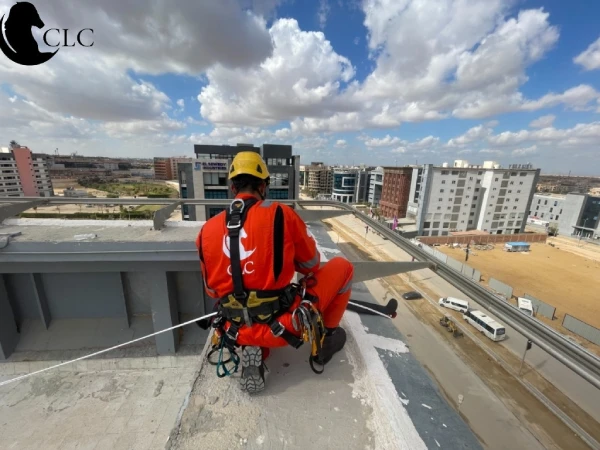
Working at height remains one of the most critical safety challenges in construction and industrial environments. A properly engineered Horizontal Lifeline System (HLL) is one of the most reliable fall protection solutions, ensuring worker safety while allowing mobility on elevated surfaces.
At Capital Leading Company (CLC), we design engineered HLL systems in line with international safety standards and site-specific conditions to ensure maximum safety, compliance, and reliability across all industrial applications.
This guide explains how HLL systems work, their engineering principles, key design calculations, and compliance requirements according to standards such as OSHA, EN795, and ANSI.
What is a Horizontal Lifeline System HLL?
A Horizontal Lifeline System (HLL) is a fall protection system consisting of a flexible line—typically a steel cable or engineered rope—anchored between two or more secure points. It allows workers to move horizontally on roofs, steel structures, or elevated platforms while remaining continuously connected to the safety system.
Typical applications include:
- Industrial rooftops
- Warehouses and logistics centers
- Bridges and steel structures
- Maintenance platforms
- Overhead working zones
Workers connect to the system using:
- A full-body harness.
- A shock-absorbing lanyard or a Self-Retracting Lifeline.
Why Horizontal Lifeline Systems Require Engineering Design
A common misconception is that installing a simple cable between two anchors is sufficient for fall protection. In reality, HLL systems are dynamic safety systems that behave differently under fall conditions.
Without proper engineering, a system may:
- Exceed safe arrest forces
- Fail at anchor points
- Provide insufficient clearance distance
- Cause secondary injuries during arrest
This is why HLL systems must be designed using precise structural and dynamic load analysis, not field estimation.
Fall Protection Modes: Fall Arrest vs. Fall Restraint
Before designing any system, the protection strategy must be defined:
Fall Arrest System A system designed to stop a fall after it occurs. It requires:
- Energy absorption devices
- Higher clearance distance
- Strict load calculations
Fall Restraint System A preventive system that restricts the worker from reaching the fall hazard zone. It is preferred when:
- Clearance distance is limited
- Roof edges are close to work areas
- Risk of fall arrest impact is too high
Choosing the correct system type is a critical engineering decision that directly impacts safety performance.
Key Design Criteria for HLL Systems
Horizontal Lifeline systems must be designed according to strict engineering principles and safety standards to ensure system strength, user protection, and compliance with international regulations under dynamic load conditions.
Load Capacity and Structural Strength
All system components must withstand dynamic fall loads, including:
- Maximum Arrest Force (MAF)
- Maximum Arrest Load (MAL)
These forces depend on span length, number of users, and anchor configuration.
2. Limiting Impact Forces on the Worker
The system must ensure that the force transmitted to the worker remains within acceptable safety thresholds defined by international standards.
This is achieved through:
- Energy absorbers
- Controlled cable deflection
- Proper system stiffness design
3. Clearance Distance Requirement
Clearance distance is one of the most critical design factors in HLL systems.
It ensures that in case of a fall, the worker does not strike a lower surface.
Clearance calculation includes:
- Lanyard length
- Deceleration distance
- Harness stretch
- Safety margin
4. System Geometry and Installation Variables
The performance of an HLL system depends on multiple interconnected factors:
- Anchor height and spacing
- Cable type (steel wire rope or synthetic rope)
- Number of users
- Roof edge distance
- Surface type (steel, concrete, wood)
- System length and tension
A change in any single variable affects the entire system behavior under load.
Engineering Calculation of HLL Systems
Modern HLL systems require simulation-based software tools rather than manual estimation to accurately predict system behavior under dynamic fall conditions.
Professional systems use platforms such as ODIN engineering software to calculate:
- Maximum Arrest Force (MAF)
- Maximum Arrest Load (MAL)
- Maximum Intermediate Loads (MIL)
- Cable tension forces
- System deflection under dynamic load
These calculations ensure compliance with international regulations, including:
- OSHA 1926 Subpart M
- EN795:2012
- CSA Z259 standards
Need Certified HLL Design & Calculations? Ensure full compliance with OSHA & EN795 standards. Contact CLC’s engineering team today for precise, software-backed simulation for your site.
Why Manual Design of HLL Systems is Risky
Manual calculations often fail to account for:
- Dynamic fall behavior
- Cable elasticity
- Multi-user scenarios
- Anchor interaction effects
This can lead to:
- System failure under load
- Unsafe force transmission to workers
- Legal liability and non-compliance issues
Engineering validation is therefore essential for every installation.
Horizontal Lifeline System Standards
Any compliant HLL system must follow international regulations:
- OSHA (USA): Fall protection requirements and minimum strength criteria
- EN795 (Europe): Anchor device classification and testing
- ANSI Z359: Personal fall arrest system requirements
- CSA Z259 (Canada): Lifeline system design rules
Compliance ensures both legal safety and engineering reliability.
How Engineered HLL Systems Improve Safety
A properly designed system provides:
- Controlled fall arrest forces
- Reduced risk of anchor failure
- Optimized system deflection
- Worker mobility without compromising safety
- Verified structural performance
Why Choose Engineered HLL Solutions from Capital Leading Company
At Capital Leading Company, Horizontal Lifeline Systems are designed as fully engineered safety solutions, not just installed components.
Engineering Expertise Each system is designed by qualified safety and structural engineers with experience in fall protection systems for industrial and commercial projects.
Data-Driven Design All HLL systems are validated using advanced calculation tools to ensure:
- Accurate load prediction
- Compliance with international standards
- Optimized safety performance
Compliance Assurance Designs are aligned with international regulations, including:
- OSHA
- EN795
- ANSI Z359
- CSA Z259
Site-Specific Engineering Each project is individually analyzed based on:
- Structure type
- Work environment
- Load conditions
- User requirements
At CLC, we specialize in QC inspection using rope access, providing a cost-effective and highly precise alternative to traditional scaffolding for structural evaluations.
Typical HLL System Failure Causes (and How They Are Avoided)
Many systems fail due to:
- Incorrect anchor placement
- Underestimated fall clearance
- Lack of energy absorption
- Improper cable tension
Engineered systems eliminate these risks through:
- Simulation-based design
- Load verification reports
- Site-specific calculations
Protecting lives at height leaves no room for estimation; engineered HLL systems verified by advanced software are your only guarantee for compliance and safety. At CLC, we combine global standard designs (OSHA, EN795) with cost-effective Rope Access structural evaluations to deliver bulletproof fall protection.
[Contact CLC’s Engineering Team Today for a Certified Consultation]
Frequently Asked Questions
What is a horizontal lifeline system?
A Horizontal Lifeline (HLL) is a fall protection system designed to keep workers safe while working at height It consists of a tensioned cable or rail secured between anchor points, allowing workers to connect their fall protection equipment safely.
What is the difference between a vertical lifeline and a horizontal lifeline?
The primary difference is the direction of movement. Vertical lifelines protect workers moving up and down (such as on ladders or towers), while horizontal lifelines ensure safety during lateral movement across flat or sloped surfaces
What is the fall clearance for a horizontal lifeline?
Free fall should not exceed 6 feet unless explicitly designed otherwise. The total fall clearance is calculated by adding the lanyard length, deceleration distance, harness stretch, and lifeline deflection under dynamic load, plus a safety margin.
Why Should I Choose CLC for Horizontal Lifeline Systems?
CLC provides fully engineered and certified HLL systems using advanced software tools to ensure maximum safety, full compliance with international standards (OSHA, EN795), and customized solutions tailored to your site-specific requirements.